A well-designed, complete, and engaging syllabus is key for a successful course. The syllabus can act as both a contract with students and as a roadmap for what students should know, value, and be able to do by the end of the course.
The Koehler Center offers accessible syllabus templates to assist faculty in creating comprehensive and engaging course outlines. These templates include links and QR codes to TCU Student Resources & Policy Information.
Available Resources
Most Recent Syllabus Template
AI Syllabus Statement (Optional Draft from the AI Teaching & Learning Committee)
AI Policy Syllabus Statement
This syllabus includes information about when, how, and which forms of AI are required, permitted, restricted, or prohibited in this course. When AI use varies from the general course expectations for specific activities, you can expect activity-level instructions. If in doubt, you as a student, should ask the instructor before submitting work. If you use AI in this or any course, you are responsible for the accuracy, quality, and integrity of the coursework you submit including any errors, fabrications, or biases the AI may produce. Your critical judgment is crucial in determining how you use AI. Once included in your coursework, you are responsible for any misinformation. AI technology is not responsible.
If faculty use AI to assess student work, you can expect a disclosure of this use in this syllabus and assessment descriptions. Faculty, like students, are responsible for their use of AI-generated material. This course syllabus may also include instructions on how to disclose and cite your use of AI. Presenting AI-generated content as one’s original work is a violation of TCU’s Academic Conduct Policy. Blaming AI shall not be accepted as an excuse or defense at TCU.
Related Links
Want help designing your syllabus?
For assistance in designing your syllabus in the new template, you can schedule a one-on-one Teaching & Learning Consultation. You can also watch the Syllabus Template Overview video tutorial below at a time of your convenience.
The Koehler Center periodically provides syllabus development workshops. When workshops are available, you can find them and register through our Events webpage. To learn about the accessibility features that are built into the syllabus template, you can watch this video on syllabus template accessibility.
Student Resources & Policy Information
TCU Student Resources & Policy Information houses the approved Syllabus Policy Statements. Each D2L course has a navigation bar link to the policies and resources webpage.
TCU Student Resources & Policy Information can also be shared via link or QR Code in print or digital syllabi:
- Share this link: https://cte.tcu.edu/tcu-syllabus-policies/
- QR code (right click and download the linked file)

See Faculty Handbook – Academic Responsibilities and Procedures for Course Syllabus and other policies.
FAQ
Since 2007, TCU has provided syllabus templates consistent with TCU policies and best practices. Starting in the Spring of 2025, it is required that all faculty use the template as you create your course syllabi.
Creation of the syllabus template was an iterative process that took place over the course of many months. The Streamlining the Syllabus Template Committee included representation from the faculty senate and faculty as well as undergraduate and graduate student government representatives.
- Accessibility: An accessible template ensures all students can access the content in your syllabus through screen readers and other types of technology.
- Accreditation: A syllabus template with a common format is an efficient way to provide documentation of many elements required for SACSCOC accreditation.
- Clear & Consistent: Including clear and consistent expectations, policies, and procedures in the syllabus provide better outcomes for all.
- Student-Focused: A syllabus that is accessible, well-organized, and includes elements based on best-practices can have a positive impact on students (e.g. DiClementi & Handelsman, 2005; Harrington & Gabert-Quillen, 2015; Richmond et al., 2013; Richmond et al., 2014; Richmond et al., 2016; Saville et al., 2010).
Required headings and content in the template are denoted by a red asterisk in the image below.
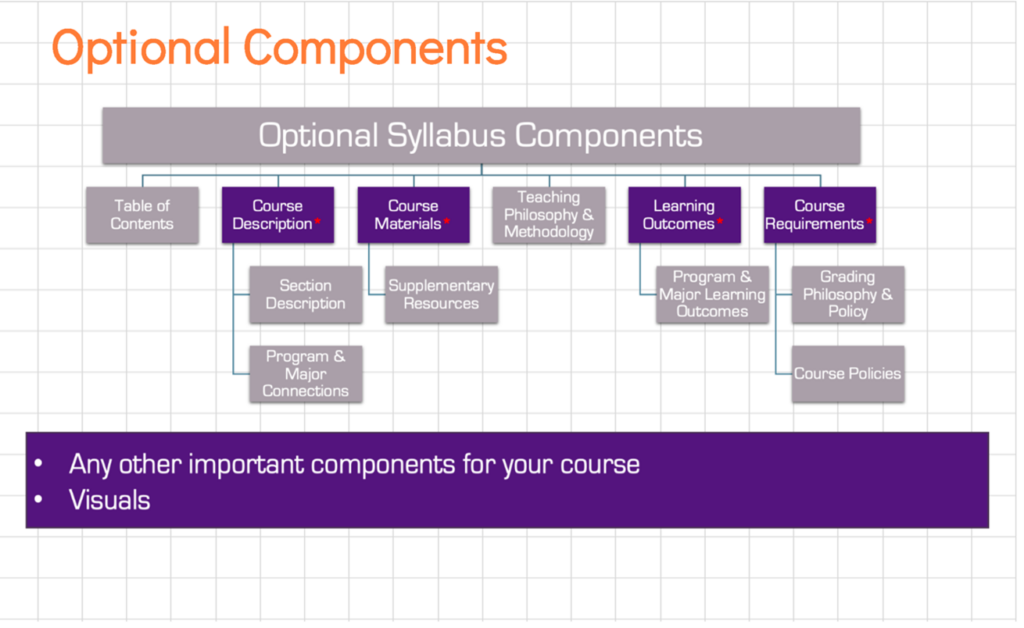
If an item in the template does not have a red asterisk next to it, it is optional.

After copying the content from your old syllabus, use these keyboard and mouse shortcuts to ensure accessibility and consistent formatting. When copying and pasting, you need to make sure that you select “Use of match Destination Styles/Theme/Formatting.”

To ensure consistency, please use the headings provided. If you would like to change the order of the headings, please check with your college leadership first.
Once you have the required items in your syllabus, feel free to add headings and/or content that you think are important. Let students know who you are and what you think is important. While the format of the common syllabus is standard, the choice of fonts, colors and graphics as well as the tone in which you communicate expectations to students is up to you.
- Course Component Type: To find out your course’s component type, look it up in Class Search. Look at the three-digit code under “Type”. Explanations of these codes can be found here.
- Preferred Method of Contact: Remember to include your preferred method of contact whether it’s email, text, D2L, or some other method.
- Connection Among Each Assignment and Learning Outcome(s): Show the connection between each assignment and your learning outcomes. An easy way to do this is to number each of your learning outcomes and list the outcomes after each assignment or within the table of each assignment‘s contribution to the final grade.
Accessibility of documents can be challenging. We’ve created an on-demand video that specifically addresses the accessibility features of the syllabus template. If you still have questions about accessibility after watching the video, please email us at koehlercenter@tcu.edu.
If you have questions while working on your syllabi, please reach out for help. We offer on-demand videos on our website as well as one-on-one consultations.